MapleCub Data Lab · Methodology
How the dataset is built, and where every figure comes from
Everything MapleCub publishes about the size and shape of Canada’s licensed child-care sector comes from one dataset. This page describes how it is assembled, what each step can and cannot support, and where the numbers stop being ours and start being someone else’s.
- Current edition computed 2026-08-10
- Sources audited 2026-08-11
- 40 entries in the citation registry
- CC BY 4.0
20,516
licensed programs
45.9%
address-level coordinates
290
duplicates merged and excluded
40
government sources on file
Sources
The base layer is the eight provincial licensing registries: British Columbia, Ontario, Quebec, Alberta, Saskatchewan, Manitoba, New Brunswick and Nova Scotia. Each province publishes its own list of licensed programs under its own rules, in its own format, on its own schedule. We ingest the province’s own file or portal, never a third-party aggregator, and we keep the identifier the province assigned to each record. The remaining provinces and the territories are not covered yet; when a registry becomes available, it arrives as a new edition rather than a silent backfill.
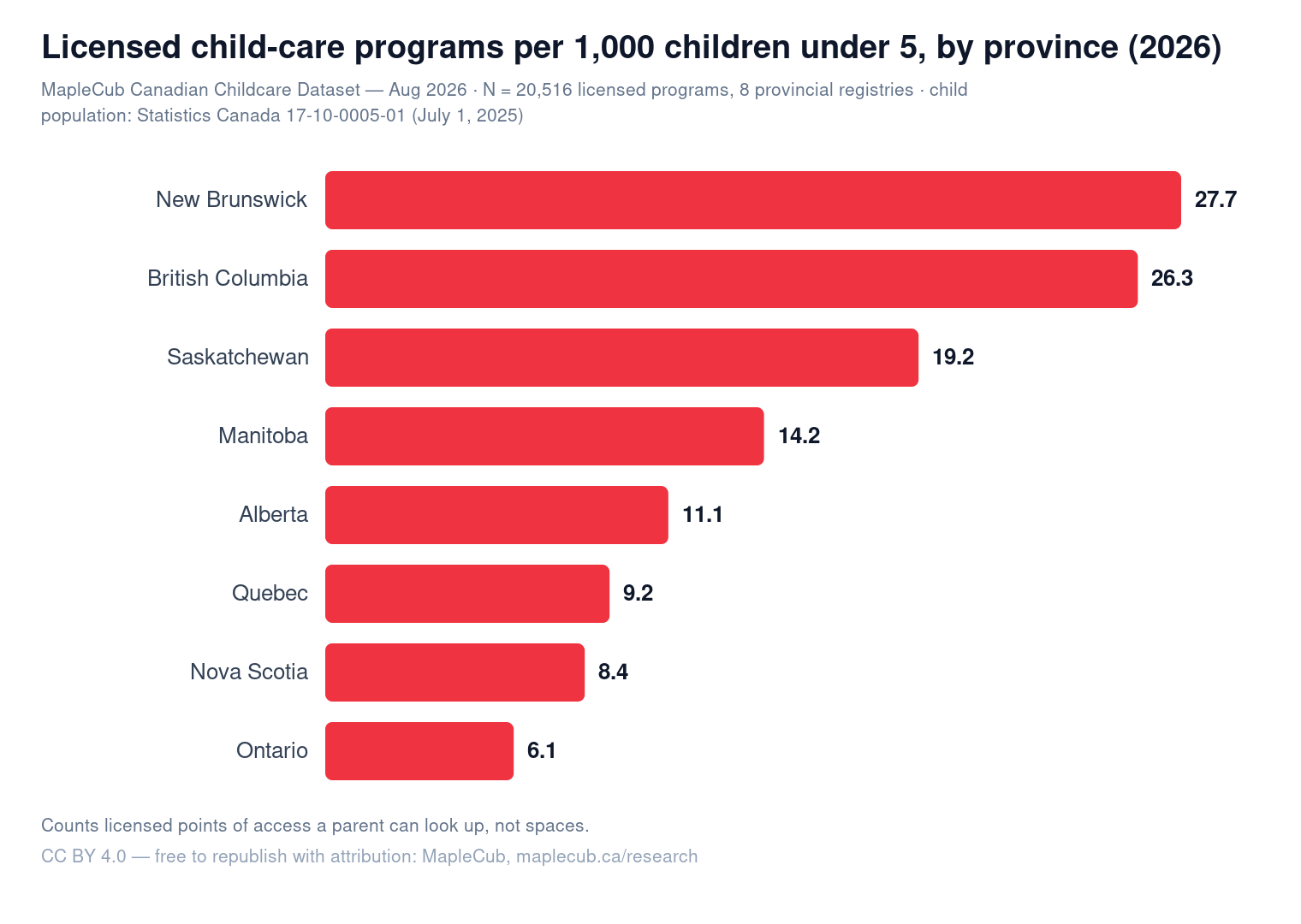
Registry scope differs, and the difference matters more than any single count. British Columbia and New Brunswick license small family child cares one at a time, so each home is a row. Ontario licenses home child care through agencies, so thousands of homes sit behind a few hundred agency records. Quebec’s home-based care runs through coordinating offices and does not appear as individual listings at all. Program counts are therefore counts of licensed points of access a parent can look up. They say nothing about how many spaces exist behind those licences, or how many children are served.
Website counts are frozen to the quarterly snapshot (metric_snapshots, 2026Q3) at 7,747; MapleCub’s website-discovery process keeps running between editions, so the live directory shows more: 8,369 when it was read on 2026-08-11. The frozen figure is the citable one, and the gap is published rather than quietly closed. Website presence is not capped by Google matching (a website can arrive from a registry field or from our own harvest) but it is conditioned by it: 62.2% of matched listings carried a website against 25.3% of unmatched ones.
Cleaning and identity
- Deduplication. 290 duplicate records were identified and merged in the July 2026 dedup pass and remain excluded from every published figure. Duplicates arise when a province re-issues a licence under a new number or when the same facility appears under both a legal and an operating name.
- Registry identifiers. All 20,516 records carry the provincial registry identifier they were ingested with, so any row can be traced back to the province’s own listing.
- Geocoding, and what “geocoded” is worth. 20,481 of 20,516 records (99.8%) carry coordinates, and that number on its own is close to meaningless, so we no longer publish it on its own. Of those, 9,400 (45.9%) are address-level and 11,081 (54.1%) are the centroid of a postal district or a city. A point counts as a centroid when more than 3 visible listings on one identical lat/lng, resolving to more than 1 distinct street address: one address carrying several licences is a building, several addresses on one point are not. The threshold errs toward calling a centroid an address, so the centroid share is a floor.
- Where the coordinate is an address, and where it is not. Address-level in British Columbia, Nova Scotia, New Brunswick, Alberta: Alberta everywhere except its two largest cities, and a postal-district centroid in Ontario, Quebec, Saskatchewan, Manitoba. Saskatchewan's S0K resolves 57 listings in 27 separate towns to one point; Alberta pins 314 Calgary listings and 256 Edmonton listings to one point each. No count in the flagship report is computed from coordinates. The one analysis that is. The distance from a one-option community to the nearest other licensed programme, runs only in the four address-level provinces, and says so. An earlier edition of this page said “a small number of Manitoba records geocode to a municipal centroid rather than a street address,” which was wrong three times over: not a small number, not Manitoba alone, and not municipal.
- Coordinates that are missing entirely. Manitoba is the only province with records carrying no coordinate at all (1,104 of 1,139); the gap is addresses the registry publishes in a form no geocoder resolves. That is a separate and much smaller problem than the centroid split above, and listing it alone used to read as though the other seven provinces were fine.
- Communities. A community is a normalized city name, lower-cased and trimmed, empty values dropped. Manitoba and Saskatchewan both ship case variants of the same town, which a raw grouping would count twice; 47 Manitoba rows and 8 Saskatchewan rows carry no city at all and sit outside the community counts, and 35 of those 47 Manitoba rows carry no coordinates either. A 2026-08-10 repair merged registry-supplied city abbreviations in Manitoba (e.g. “Wpg”) into their proper communities wherever the community was determinable, and set the 12 that stayed unrecoverable to null; those 12 are part of the 47.
- Google matching, and why it is never a province ranking. Websites, ratings and review counts are matched conservatively: name agreement is required, so the figures undercount rather than overcount. The undercount is not uniform, which is the part that matters. We hold a Google place record for 9,252 of the 19,569 programmes in the seven enriched provinces, from 89.3% in Quebec down to 6.5% in Saskatchewan. Since a listing cannot carry a rating we never looked for, the published “share with a rating” is bounded by the match rate, and in three provinces it IS the match rate to within a rounding point.
- The floor for a claim about a province. With match coverage m and a rated-among-matched share r, the true share lies between m·r and m·r + (1 − m). We state a finding about a province’s sector only where that interval is under 40 points wide, match coverage of at least 60%, which admits Quebec, Alberta, Nova Scotia and nobody else. Provinces that have not been through the matching step at all are excluded from presence figures rather than reported as zero. New Brunswick is in that state today, which is why the presence denominator is 19,569 rather than 20,516, and the floor above is that same rule, applied to every province instead of one.
- Age bands are a coverage field too. Where a registry publishes age groups we can separate out-of-school-care programmes from early-years ones. Coverage ranges from every row in Quebec and New Brunswick to roughly one row in six in British Columbia, Ontario and Saskatchewan, so a count of school-age-only programmes is a floor in three provinces and close to a census in five. The flagship report publishes the per-1,000 rate on all licensed programmes for that reason, with the exclusion shown beside it and ranked nowhere.
Source: MapleCub Canadian Childcare Dataset — Aug 2026 · computed 2026-08-10 · N = 20,516 · CSV
External figures
Child population denominators are Statistics Canada, Table 17-10-0005-01 (July 1, 2025 estimates), the July 1, 2025 estimates for ages 0 to 4, total gender. Fee and subsidy rules are verified against each province’s own regulation, funding guideline or parent-facing page (2026-07-05 for the seven provinces in our audited rules module; New Brunswick’s 2026 Parent Fee Grid is cited to the Government of New Brunswick directly). Inspection and enforcement counts are the provinces’ own published records, reported as dated extracts with the window they cover, because re-downloading those files today will not reproduce our numbers.
The sourcing rule
Every external claim in the Data Lab is cited to the government page it came from, with the date we fetched it, in the registry at the foot of this page. Figures computed from MapleCub’s own dataset are not cited to anyone else: they carry the dataset line and the CSV instead, and they are ours to defend. Where a source has moved on since our figure was computed, or where we could not open the page ourselves, the citation carries a dagger and the entry says why in plain words: 5 of the 40 entries do today. Sources were last audited 2026-08-11.
What MapleCub does not do
We do not compute safety scores. We do not rank providers by inspection history, and we do not turn violation counts into stars, grades or league tables. Provinces publish inspection data on wildly different terms. Three as bulk open data (as dated extracts of files that keep moving), three one facility at a time, two not at all, and even the three per-facility routes are not the same route: New Brunswick publishes inspection reports, British Columbia publishes summary reports of inspections and substantiated complaints through five separate health authorities, and Ontario publishes only confirmed violations and offences while withholding its own file of assessment results. Any comparative score would therefore mostly measure which government publishes more, not which centre is safer. “No violations on record” in a province that publishes no records means nothing, and we say so rather than letting a blank field imply a clean history.
The same discipline applies to our own coverage fields, which is the change this edition makes. A field that records how far a MapleCub pipeline has reached, how many listings we matched to Google, whether a coordinate is an address or a postal-district centroid, whether a registry told us a programme’s age band, is published as coverage, with the denominator that says how much of the province it observed, and no province is ranked on one. We publish what we measured, labelled as what it is.
Cadence and versioning
We snapshot the dataset quarterly. Each edition carries the date it was computed, and published editions are not rewritten in place. When a province is added or a registry reissues its file, the next edition states what moved. Citations should name the edition date, so a figure quoted in July still checks out after an August edition changes the national total.
Licence and citation
The published province-level dataset is available under CC BY 4.0: reuse it commercially or otherwise, with attribution.
MapleCub, “The State of Licensed Child Care in Canada, 2026,” 2026-08-10 edition. https://doi.org/10.5281/zenodo.21909631
That DOI always resolves to the newest edition. To pin a figure to the exact deposit it came from, cite this edition instead: https://doi.org/10.5281/zenodo.21909632. The archived deposit (CSVs, JSON, the report PDF and a README setting out how these numbers are most often misread) is at Zenodo.
Machine-readable JSON for developers: /data/state-of-child-care-2026.json: same figures as the CSV, same licence.
Source: MapleCub Canadian Childcare Dataset — Aug 2026 · computed 2026-08-10 · N = 20,516 · CSV
Looking for the product side instead: how search results are ordered, what we verify before a listing appears, what providers can and cannot pay for? That lives on MapleCub’s methodology page. Questions about the data itself: hello@maplecub.ca.
Sources
Every external claim the Data Lab publishes is cited to the government page it came from. That covers every dollar figure, every inspection count, every published rule. This is the whole registry: 40 entries across 9 groups, each recording the publisher, the document, and the date we last fetched it. Sources were audited 2026-08-11. Figures computed from MapleCub’s own dataset are not in here: they carry the dataset line and the CSV instead, and they are ours to defend. A dagger (†) marks the 5 entries that need a caveat. Either the source has moved on since our figure was computed, or we could not open the page ourselves and have said so. The reason is printed with the entry.
British Columbia
- BC-1. Province of British Columbia, Ministry of Education and Child Care · Child Care Fee Reduction Initiative — Information for families · fetched 2026-08-11 · https://www2.gov.bc.ca/gov/content/family-social-supports/caring-for-young-children/childcarebc-programs/child-care-fee-reduction-initiative-provider-opt-in-status/information-for-families
- BC-2. Province of British Columbia, Ministry of Education and Child Care · Child Care Fee Reduction Initiative — Information for families · fetched 2026-08-11 · https://www2.gov.bc.ca/gov/content/family-social-supports/caring-for-young-children/childcarebc-programs/child-care-fee-reduction-initiative-provider-opt-in-status/information-for-families
- BC-4†. Province of British Columbia, BC Data Catalogue · Child Care Map Data · fetched 2026-08-11 · https://catalogue.data.gov.bc.ca/dataset/child-care-map-data† Not verified: this page could not be opened on 2026-08-11 from our environment, so the claim it supports is stated in its narrowest form and flagged in the text.
Alberta
- AB-1. Government of Alberta, Education and Childcare · Childcare fees · fetched 2026-08-11 · https://www.alberta.ca/childcare-fees
- AB-2†. Government of Alberta, Open Government Program · Child Care Information [2021 to current] · fetched 2026-08-11 · https://open.alberta.ca/opendata/childcareinformation† Source has moved on since our figure was computed. Our number is published as a dated extract, not as the current record.
Saskatchewan
- SK-1. Government of Saskatchewan, Education · Child Care Updates · fetched 2026-08-11 · https://www.saskatchewan.ca/residents/family-and-social-support/child-care/child-care-updates
- SK-2. Government of Saskatchewan, Education · Child Care Updates — Changes Under the Extension Agreement · fetched 2026-08-11 · https://www.saskatchewan.ca/residents/family-and-social-support/child-care/child-care-updates
- SK-3. Government of Saskatchewan, Education · Child Care Updates — Standard hours of care · fetched 2026-08-11 · https://www.saskatchewan.ca/residents/family-and-social-support/child-care/child-care-updates
Manitoba
- MB-1. Province of Manitoba, Education and Early Childhood Learning · Child Care Fees · fetched 2026-08-11 · https://www.gov.mb.ca/education/childcare/families/childcare_fees.html
- MB-2. Province of Manitoba, Education and Early Childhood Learning · Child Care Fees — finding a funded facility · fetched 2026-08-11 · https://www.gov.mb.ca/education/childcare/families/childcare_fees.html
- MB-3. Province of Manitoba, Education and Early Childhood Learning · $10 a Day Child Care · fetched 2026-08-11 · https://www.gov.mb.ca/education/childcare/families/10_dollar_a_day.html
Ontario
- ON-1. Government of Ontario, Ministry of Education · Canada-Ontario early learning and child care agreement · fetched 2026-08-11 · https://www.ontario.ca/page/canada-ontario-early-years-and-child-care-agreement
- ON-2. Employment and Social Development Canada · Canada and Ontario agree to one-year extension of the Canada-wide early learning and child care agreement · fetched 2026-08-11 · https://www.canada.ca/en/employment-social-development/news/2025/12/canada-and-ontario-agree-to-one-year-extension-of-the-canada-wide-early-learning-and-child-care-agreement.html
- ON-3. Government of Ontario, Ministry of Education · Licensed child care facilities in Ontario · fetched 2026-08-11 · https://data.ontario.ca/dataset/licensed-child-care-facilities-in-ontario
- ON-4. Government of Ontario, Ministry of Education · Compliance of licensed child care facilities with licensing requirements · fetched 2026-08-11 · https://data.ontario.ca/dataset/compliance-of-licensed-child-care-facilities-with-licensing-requirements
- ON-5. Government of Ontario, Ministry of Education · Serious incidents in licensed child care facilities · fetched 2026-08-11 · https://data.ontario.ca/dataset/serious-incidents-in-licensed-child-care-facilities
- ON-6. Government of Ontario, Ministry of Education · Consequences for breaking child care rules · fetched 2026-08-11 · https://www.ontario.ca/page/consequences-breaking-child-care-rules
- ON-7. Government of Ontario, Ministry of Education · Ontario's Early Years and Child Care Annual Report 2025 · fetched 2026-08-11 · https://www.ontario.ca/page/ontarios-early-years-and-child-care-annual-report-2025
Quebec
- QC-1. Gouvernement du Québec (Ministère de la Famille) · Educational childcare rates · fetched 2026-08-11 · https://www.quebec.ca/en/family-and-support-for-individuals/childhood/childcare-centres/costs
- QC-2. Éditeur officiel du Québec (LégisQuébec) · Règlement sur la contribution réduite, chapitre S-4.1.1, r. 1 · fetched 2026-08-11 · https://www.legisquebec.gouv.qc.ca/fr/document/rc/S-4.1.1,%20r.%201
- QC-3. Ministère de la Famille (Québec) · Règles budgétaires 2026-2027 – Centres de la petite enfance — Faits saillants · fetched 2026-08-11 · https://cdn-contenu.quebec.ca/cdn-contenu/adm/min/famille/publications-adm/Service_de_garde/finance/FS-RB-CPE-2026-2027.pdf
- QC-4. Gouvernement du Québec (Ministère de la Famille) · Documents financiers et reddition de comptes pour les services de garde · fetched 2026-08-11 · https://www.quebec.ca/famille-et-soutien-aux-personnes/enfance/garderies-et-services-de-garde/reseau/gestion/gestion-finances/documents-financiers-reddition-compte
- QC-5. Ministère de la Famille (Québec) · Registre des pénalités administratives — 1er juillet 2025 au 30 septembre 2025 · fetched 2026-08-11 · https://cdn-contenu.quebec.ca/cdn-contenu/adm/min/famille/publications-adm/Service_de_garde/conformite/24-Registre-PA-WEB-Du-2025-07-01-Au-2025-09-30.pdf
- QC-6†. Gouvernement du Québec (Ministère de la Famille) · Inspection de conformité législative et réglementaire en services de garde · fetched 2026-08-11 · https://www.quebec.ca/famille-et-soutien-aux-personnes/enfance/garderies-et-services-de-garde/reseau/responsabilites/conformite-inspections/conformite† Source has moved on since our figure was computed. Our number is published as a dated extract, not as the current record.
- QC-7. Gouvernement du Québec (Ministère de la Famille) · Inspection de conformité législative et réglementaire en services de garde — Résultats d'inspection · fetched 2026-08-11 · https://www.quebec.ca/famille-et-soutien-aux-personnes/enfance/garderies-et-services-de-garde/reseau/responsabilites/conformite-inspections/conformite
- QC-8. Ministère de la Famille (Québec), via Données Québec · Liste des centres de la petite enfance (CPE), garderies et bureaux coordonnateurs en fonction · fetched 2026-08-11 · https://www.donneesquebec.ca/recherche/dataset/liste-des-centres-de-la-petite-enfance-cpe-et-des-garderies-en-fonction
New Brunswick
- NB-1. Government of New Brunswick, Education and Early Childhood Development · Information for families — Parent fee grid (reduced parent fees) · fetched 2026-08-11 · https://www2.gnb.ca/content/gnb/en/corporate/promo/investing-in-early-learning-and-child-care/information-for-families.html
- NB-2. Government of New Brunswick, Education and Early Childhood Development · Information for families — Childcare financial assistance · fetched 2026-08-11 · https://www2.gnb.ca/content/gnb/en/corporate/promo/investing-in-early-learning-and-child-care/information-for-families.html
- NB-3. Government of New Brunswick, Education and Early Childhood Development · Early Learning and Childcare Facility Inspection Reports · fetched 2026-08-11 · https://www2.gnb.ca/content/gnb/en/departments/education/elcc/content/inspection_reports.html
Nova Scotia
- NS-1. Government of Nova Scotia, Department of Education and Early Childhood Development · How it works: 50 per cent fee reduction · fetched 2026-08-11 · https://childcarenovascotia.ca/families/50-percent-fee-reduction
- NS-2†. Government of Nova Scotia, Department of Education and Early Childhood Development · How it works: 50 per cent fee reduction — fee reduction table · fetched 2026-08-11 · https://childcarenovascotia.ca/families/50-percent-fee-reduction† Not verified: this page could not be opened on 2026-08-11 from our environment, so the claim it supports is stated in its narrowest form and flagged in the text.
- NS-3†. Open Data Nova Scotia, Department of Education and Early Childhood Development · Child Care Directory · fetched 2026-08-11 · https://data.novascotia.ca/api/views/3j9v-yimg.json† Source has moved on since our figure was computed. Our number is published as a dated extract, not as the current record.
National and cross-province
- CA-1. Statistics Canada · Table 17-10-0005-01 Population estimates on July 1, by age and gender · fetched 2026-08-11 · https://www150.statcan.gc.ca/t1/tbl1/en/tv.action?pid=1710000501
- CA-2. Employment and Social Development Canada · Canada and Ontario agree to one-year extension of the Canada-wide early learning and child care agreement — Quick facts · fetched 2026-08-11 · https://www.canada.ca/en/employment-social-development/news/2025/12/canada-and-ontario-agree-to-one-year-extension-of-the-canada-wide-early-learning-and-child-care-agreement.html